Why this matters
Plants breathe. They exchange gases, release moisture and produce powerful odor in flowering. A tent without proper ventilation cooks plants, grows mold and fills the house with smell.
Ventilation is also the easiest part of a grow to get right once you understand the basic math.
What to look for
Inline fan
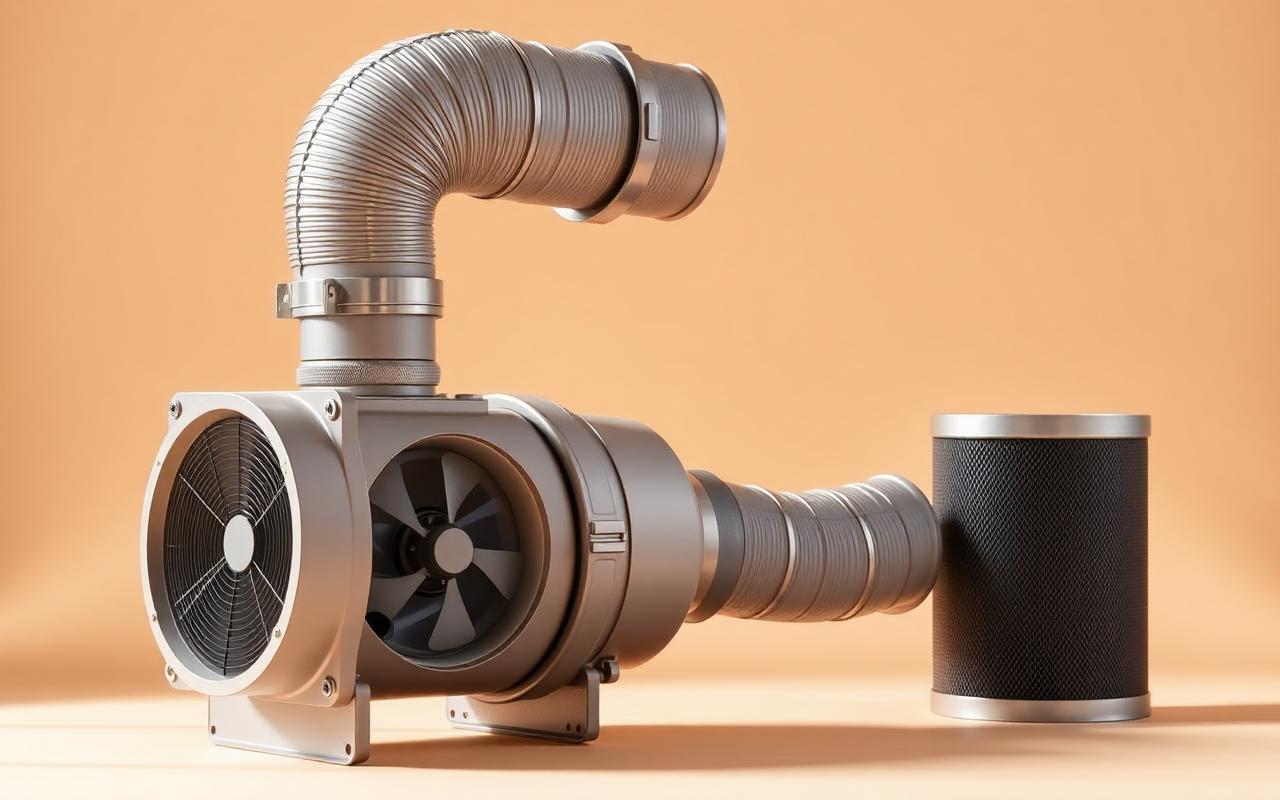
The heart of the system — pulls air through the tent and out through ducting.
Carbon filter
Activated carbon scrubs odor molecules out of the exhaust air. Mandatory for flowering.
Passive intake
Low vents on the tent that let fresh air in as the fan pulls air out.
Oscillating fan
Moves air inside the tent, strengthens stems and prevents hot spots.
CFM rating
Cubic feet per minute — match to tent volume for proper air exchange.
Speed controller
Lets you dial down fan noise during quiet hours without killing airflow.
Budget, mid range or premium?
Here is what each level actually buys you.
Basic ventilation kit
$80 – $150
4-inch inline fan, carbon filter and ducting for a small tent.
Best for
2x2 or 2x4 tents.
Mid-range setup
$150 – $300
6-inch fan with speed controller, premium carbon filter, two oscillating fans.
Best for
Most 2x4 to 4x4 tents.
Premium quiet system
$300 – $600
EC-motor fan, professional carbon filter, smart controller, multiple circulation fans.
Best for
Multi-tent setups or growers needing silent operation.
Watch out for
Overkill for a single small tent.
Common mistakes
MistakeUndersizing the inline fan.
FixCalculate tent volume (LxWxH in cubic feet) and pick a fan that can exchange the air every 1-3 minutes.
MistakeBuying a carbon filter that's too small for the fan.
FixThe fan should match or be slightly weaker than the filter's max CFM. Over-pulling reduces filter effectiveness.
MistakeMounting the filter outside the tent.
FixThe filter goes inside on the intake side of the fan so it scrubs air before it exits the tent. External filters miss leaks at the tent.
MistakeForgetting passive intake.
FixIf the tent walls suck inward, you need bigger or more intake vents. The tent should hold a slight negative pressure without flexing.
MistakeSkipping the oscillating fan.
FixWithout internal circulation, you get hot pockets, weak stems and mold-friendly stagnant areas. A $20 clip-on fan solves all three.
The full guide
Sizing the inline fan. Take tent volume in cubic feet (length x width x height). Multiply by 1-3 depending on how often you want air exchanged per minute (every minute = high; every 3 = low). That's your minimum CFM. For a 2x4x6 (48 cu ft), a 200+ CFM fan is plenty.
Carbon filter basics. Activated carbon adsorbs terpene and other odor molecules as air passes through. Filter quality depends on the carbon source and depth of the carbon bed. RC 412 Australian carbon is the gold standard; cheap pellet carbon works at first but exhausts quickly.
Pairing fan and filter. Match CFM ratings — a 6-inch filter with a 6-inch fan, both rated around 400 CFM, works well together. If the fan over-pulls the filter, air rushes past the carbon without being scrubbed.
Negative pressure. Properly ventilated tents pull slightly inward at the walls. This means all smell exits through the filter, not through tent seams. Add more passive intake or open zippers slightly if the tent crushes inward.
Noise management. EC-motor fans run quieter than AC. A simple variable speed controller cuts noise dramatically by reducing fan RPM during dark periods or when full power isn't needed.
See our other home grow equipment guides linked below to round out your setup.
Common Questions
Do I need a carbon filter to grow indoors?
Yes for flowering. The odor from a single flowering plant is strong enough to fill a house. Vegetative-stage plants have much less smell, but the filter is part of the standard kit either way.
What size inline fan for a 2x4 grow tent?
A 4-inch inline fan rated around 190-200 CFM is the standard for a 2x4 tent. Pair it with a matching 4-inch carbon filter.
Can I just use a regular box fan?
Inside the tent for circulation, yes. As exhaust, no — box fans don't move enough air against ducting resistance and can't connect to carbon filters.
How long do carbon filters last?
Quality filters with Australian RC 412 carbon last 18-24 months of continuous use. Cheap filters can lose effectiveness within 6 months.
How do I quiet down a noisy inline fan?
Three options: variable speed controller, EC-motor fan (quieter by design) or a 'duct silencer' inline muffler. All three together produce near-silent operation.
Frequently asked
Do I need a carbon filter to grow indoors?
Yes for flowering. The odor from a single flowering plant is strong enough to fill a house. Vegetative-stage plants have much less smell, but the filter is part of the standard kit either way.
What size inline fan for a 2x4 grow tent?
A 4-inch inline fan rated around 190-200 CFM is the standard for a 2x4 tent. Pair it with a matching 4-inch carbon filter.
Can I just use a regular box fan?
Inside the tent for circulation, yes. As exhaust, no — box fans don't move enough air against ducting resistance and can't connect to carbon filters.
How long do carbon filters last?
Quality filters with Australian RC 412 carbon last 18-24 months of continuous use. Cheap filters can lose effectiveness within 6 months.
How do I quiet down a noisy inline fan?
Three options: variable speed controller, EC-motor fan (quieter by design) or a 'duct silencer' inline muffler. All three together produce near-silent operation.
Newsletter
Get the weekly Chill drop
Travel guides, dispensary picks, deals, and the funniest weed memes on the internet — straight to your inbox.
Subscribe free